Update 2: Adobe has now published an official Group Policy Administrative template that has a pre-configured setting to disable Java Script. Check out my ne blog post How to configure Group Policy for Adobe Reader XI for instructions. Update: This article is a re-publish of a post I have previously posted. This time I have updated the "Configuring Automatic Update for Adobe Reader" section below with now an officially documented and more reliable method. I have also added a section called "Locking down the Automatic Update option for Adobe Reader" which shows you how to prevent users from changing Adobe Reader update options once they are configured. Recently there have been a number of critical security issues that have been associated with Adobe Reader (see below).
- http://securitygarden.blogspot.com/2010/06/security-advisory-adobe-flash-player.html
- http://securitygarden.blogspot.com/2010/04/critical-adobe-and-adobe-acrobat-update.html
- http://securitygarden.blogspot.com/2010/01/adobe-readeracrobat-critical-update.html
- http://securitygarden.blogspot.com/2009/10/adobe-reader-and-acrobat-critical.html
- http://securitygarden.blogspot.com/2009/05/critical-update-adobe-reader-and.html
- http://securitygarden.blogspot.com/2009/12/critical-adobe-pdf-vulnerability.html
- http://securitygarden.blogspot.com/2010/01/adobe-readeracrobat-critical-update.html
- http://www.adobe.com/support/security/advisories/apsa09-07.html
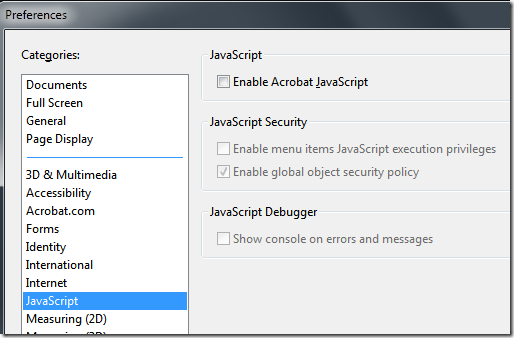
New: To see a complete list of current updates for Adobe Reader (all current versions) on Windows go to http://www.adobe.com/support/downloads/product.jsp?product=10&platform=Windows This has has left IT administrators with a bit of a nightmare as to how to keep Reader secure as Adobe don't have the wonderful tools such as Group Policy and Windows Update, WSUS and SCCM to manage their patch rollout deployment. One thing you might notice about the many of the vulnerabilities in Adobe products is that they are frequently JavaScript issues. Surprisingly the recommend action from Adobe to mitigate this security issues is to simply turn off JavaScript (which is enabled by default) in Adobe Reader. Seeing how rarely the JavaScript option is actually used in Adobe Reader I recommend that you just configure this option to be permanently turned off (see image 1).  Image 1. Adobe Reader JavaScript option
Disabling JavaScript
Now there is no way to disable the user interface you can disable the user interface using third-party tools (see http://www.policypak.com/support-and-sharing/video-tutorials) to prevent users to re-enabling this option. However some users might need to open PDF's with JavaScript content so leaving the UI enabled would allow them to re-enable the option when needed. The good thing about configuring this registry key via Group Policy Preferences is that it would automatically turn the option off in the background at the next policy update leaving JavaScript only enabled for a few hours. NICE! To do disable this option edit a Group Policy Object (GPO) that is targeted to the users accounts. Once you have opened the GPO in the Group Policy Management Editor go to User Configuration > Preferences > Windows Settings > Registry then go to Action > All Tasks > Add and configured a New Registry setting (as per image below).  Image 2. Disable JavaScript registry key The key to update is: Key: HKCU\Software\Adobe\Acrobat Reader\9.0\JSPrefs Value: bEnableJS (REG_DWORD) Data: 0 (zero) Note: If you don't want this option to be turned off once a users has re-enabled it then tick the "Apply once and do not reapply" option in the "Common" tab (see image 3) as this will only change this registry key once making it more a default setting rather then an enforced one.
  Image 3. Apply one and do not reapply
Updated: Configuring Automatic Update for Adobe Reader
Adobe has also added a "Automatically install updates" feature (see image 4) with the release of Adobe Reader 9.2.0. however as of the time of writing this document the new version of Adobe Reader 9.3.0 is out and for some reason it is not automatically updating. So maybe there is a little more work to go here for Adobe. Thanks to Ryan Steel for pointing out that Adobe have now published a document ( http://kb2.adobe.com/cps/837/cpsid_83709/attachments/Acrobat_Reader_Updater.pdf ) that documents the registry key for enabling the "Automatically install updates" option.  Image 4. Adobe Reader Updater Preferences
  Image 5. Adobe Reader Updater System Tray Notification * The key to configure automatic update is: *Key: HKEY_LOCAL_MACHINE\SOFTWARE\Adobe\Adobe ARM\1.0\ARM Value: iCheck (REG_DWORD) Data: 0 (Manual) 2 (Semi-Automatic) 3 (Automatic) Below is an example of how you would configure this registry key using Group Policy Preferences. Be sure that this key is targeted to the computer object as it is a local machine setting.
  Image 6. Group Policy Preferences Updater Registry Key As Adobe digitally sign their program this means their (not-so) quarterly security update should automatically update the program without prompting normal users for a UAC elevation prompt (ref http://kb2.adobe.com/cps/838/cpsid_83813.html). Note: Ryan did pointed out that this automatic update without a UAC prompt might not necessarily be work as expected so you will need to test this automatic update facility for your environment. Having the program digitally signed also means that you can easily prevent any older version of the program from running using AppLocker with Windows 7. If you want to see some instruction on how to do this check out my other blog post How to configure AppLocker Group Policy in Windows 7 to block third-party browsers.
New: Locking down the Automatic Update option for Adobe Reader
Another registry key that is document in this article show the key that locks down the user interface for the Adobe Reader update option. This is very handy as if you configured Adobe Updater to Automatic then locking down the UI will make it a LOT harder for users to turn this option off. The key to lock down Adobe Updater is: Key: HKEY_LOCAL_MACHINE\SOFTWARE\Polices\Adobe\{product}\{version}\FeatureLockdown Value: bUpdater (REG_DWORD) Data: 0 (Locked Down) Note: The patch listed in the Adobe documentation for this option is wrong therefore I have added "Polices" to the key above to correct for this error. Also note the above example has {product} and {version} which you should substitute the value "Acrobat Reader" and "9.0" (see image 7 below). You would obviously have to change the version number to match the version of Adobe Reader you have deployed in your environment.  Image 8. Group Policy Preferences lockdown updater Registry Key Once this key is applied to your computers you will now see that the "Check for Updates" under the help menu and the "Updater" section under preferences have now been removed (see images below).
  Image 9. "Check for Update" removed from help menu
  Image 10. "Updater" removed from Preferences While most IT professional don't like having to install Adobe Reader in their environment at least this will certainly go a long way to making it as secure as possible. It would certainly seem that McAfee labs predictions have come true ("Adobe product exploitation will likely surpass that of Microsoft Office applications in 2010.") as Steve Gibson (founder of the Gibson Research Corporation) mentioned on his latest Security Now podcast that Adobe are now looking at changing to a monthly security patching cycle as they are continuity having to release emergency out of cycles patches any way. Good Luck!!!